

Choosing the right surveillance system is one of the most important security decisions you will make for your company. When comparing NVR vs cloud CCTV, many business owners feel stuck between traditional reliability and modern convenience. Both can protect your staff, inventory, and premises, but they work in very different ways.
If you are shopping for a CCTV system Philippines businesses can depend on for 24/7 operation, understanding the difference will save you money and prevent costly upgrades later. In this guide, we break down how each business security camera system works, the pros and cons, and which option makes sense for your specific operation.
What Are NVR and Cloud CCTV Systems?
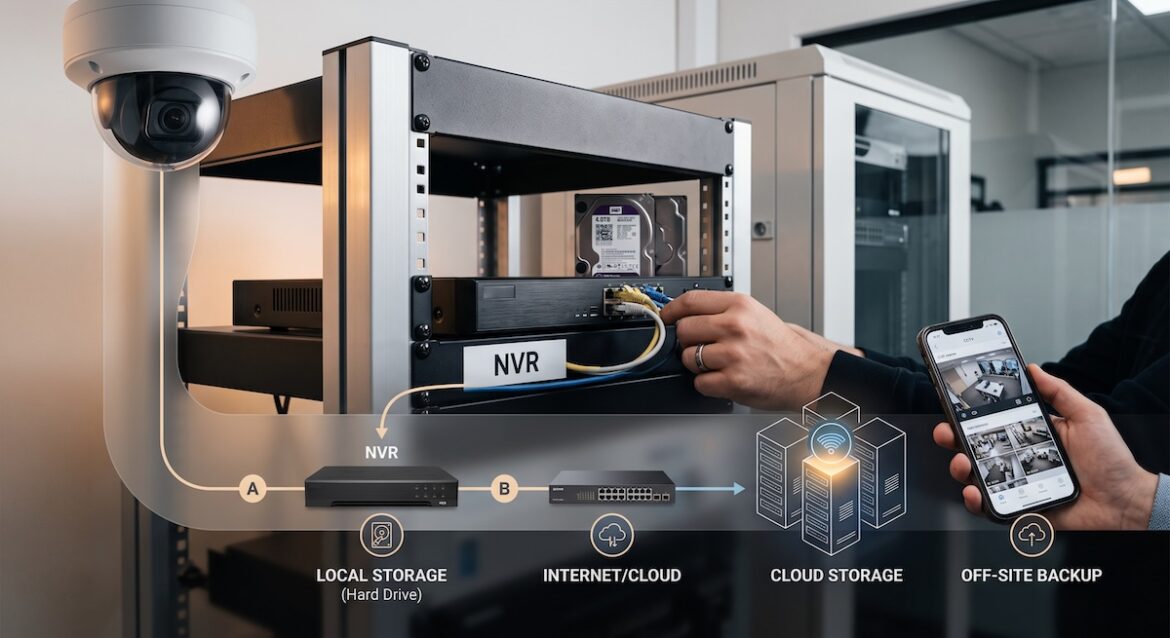
A Network Video Recorder, or NVR, is the traditional workhorse of commercial surveillance. IP cameras connect to the NVR via Ethernet cables or a local network, and all video is recorded and stored on hard drives inside the recorder at your location. You can view footage locally on a monitor or remotely through an app, but the core storage stays on-site under your control.
Cloud CCTV, on the other hand, sends encrypted video over the internet to secure off-site servers. There is no bulky recorder to maintain on-site. Instead, cameras connect to the internet and footage is stored in the cloud, which you can access anytime from your phone, laptop, or tablet. Most providers offer mobile apps, smart alerts, AI analytics, and automatic software updates as part of a monthly subscription.
In short, NVR keeps everything local, while cloud keeps everything online and accessible from anywhere. For businesses in the Philippines where branches may be in Manila, Cebu, and Davao, that difference matters a lot.
NVR vs Cloud CCTV: Pros and Cons Compared
There is no one-size-fits-all winner in the NVR vs cloud CCTV debate. The best choice depends on your internet reliability, budget, number of locations, and how you want to access footage. Here is a clear, expert breakdown:
Pros and Cons of NVR Systems:
- Pro: No monthly fees. After installation, you own your storage and there are no subscriptions.
- Pro: High-resolution continuous recording. Ideal for 24/7 recording with 4K cameras without using internet bandwidth.
- Pro: Works even during internet outages. Since recording is local, brownouts in connectivity will not stop recording as long as you have power backup.
- Pro: Full control over data. Footage stays on your premises, which many banks, warehouses, and factories prefer.
- Con: Higher upfront cost for recorder, hard drives, PoE switches, and cabling.
- Con: Vulnerable to theft or damage. If the NVR is stolen in a break-in or damaged by flood or fire, you could lose all footage.
- Con: Maintenance is on you. Hard drives need replacement every 3 to 5 years, and remote viewing setup can be technical.
Pros and Cons of Cloud CCTV Systems:
- Pro: Access from anywhere. Owners can check multiple stores, restaurants, or offices from one app in real time.
- Pro: Tamper-proof storage. Even if cameras are destroyed on-site, footage is already safe in the cloud.
- Pro: Easy to scale. Add a new camera or new branch without buying a new recorder, running complex wiring, or upgrading storage.
- Pro: Automatic updates and smart features. Get motion alerts, people counting, loitering detection, and AI search without manual upgrades.
- Con: Requires stable internet. Each business security camera needs 2 to 4 Mbps upload speed for smooth HD streaming. Weak connections in provincial areas can cause delays.
- Con: Ongoing subscription cost. You pay monthly or yearly per camera for storage retention of 7, 30, or 60 days.
- Con: Long-term cost can be higher for large systems with 32 or more cameras recording continuously.
Which Business Security Camera System Is Best for Your Business in the Philippines?
For most single-location businesses that need long, continuous recording, NVR is still the most cost-effective choice. Manufacturing plants, warehouses, hotels, condominiums, and large offices in Metro Manila often choose NVR because they have 16 to 64 cameras, an on-site security team, and a server room with UPS backup for power interruptions during typhoon season. If you have strong IT support and want maximum resolution without monthly fees, go with NVR.
Cloud CCTV is best for multi-branch and owner-managed businesses that value remote access and simplicity. Retail chains, convenience stores, cafes, clinics, and logistics offices love cloud because the owner can monitor all locations from one dashboard, receive instant alerts on shoplifting or late openings, and avoid maintaining recorders in every store. It is also ideal if you do not have on-site guards and want off-site evidence protection to comply with insurance or Data Privacy Act requirements.
- Choose NVR if: You have one large site, 16+ cameras, need 30 to 90 days local storage, have limited internet, and prefer one-time investment.
- Choose Cloud CCTV if: You have 1 to 8 cameras per site, multiple branches, travel often, want easy mobile viewing, and prefer low upfront cost with predictable monthly fees.
- Consider Hybrid if: You want local NVR recording for redundancy plus cloud backup for critical entrances and cashier areas. This is growing popular for banks and high-value retail in the Philippines.
Still unsure about NVR vs cloud CCTV for your setup? The right answer depends on your floor plan, internet speed, camera count, and retention needs. A professional site survey can prevent blind spots, bandwidth issues, and overspending on the wrong storage.
Protect your business with the right business security camera system from day one. Contact our team today for a free consultation and site assessment. We will design a reliable CCTV system Philippines companies trust, with transparent pricing, professional installation, and after-sales support tailored to your business goals.